
How Your Scanner Talks to Every App You Own
Scan from the maker's utility, a photo editor, or your operating system's built-in tool — and somehow they all drive the same hardware. A scanner driver's job is making that universal access work.
What It Does
Common Symptoms
Quick Fixes
Standard Interfaces
Implements the scanning APIs that all imaging apps expect — so any app can drive your scanner.
Multifunction Coordination
Printing and scanning are separate drivers on multifunction devices — both must be installed.
Network Return Path
Network scanning sends images back to your computer — firewalls can block this return journey.
Most Common Topics
What a Scanner Driver Does
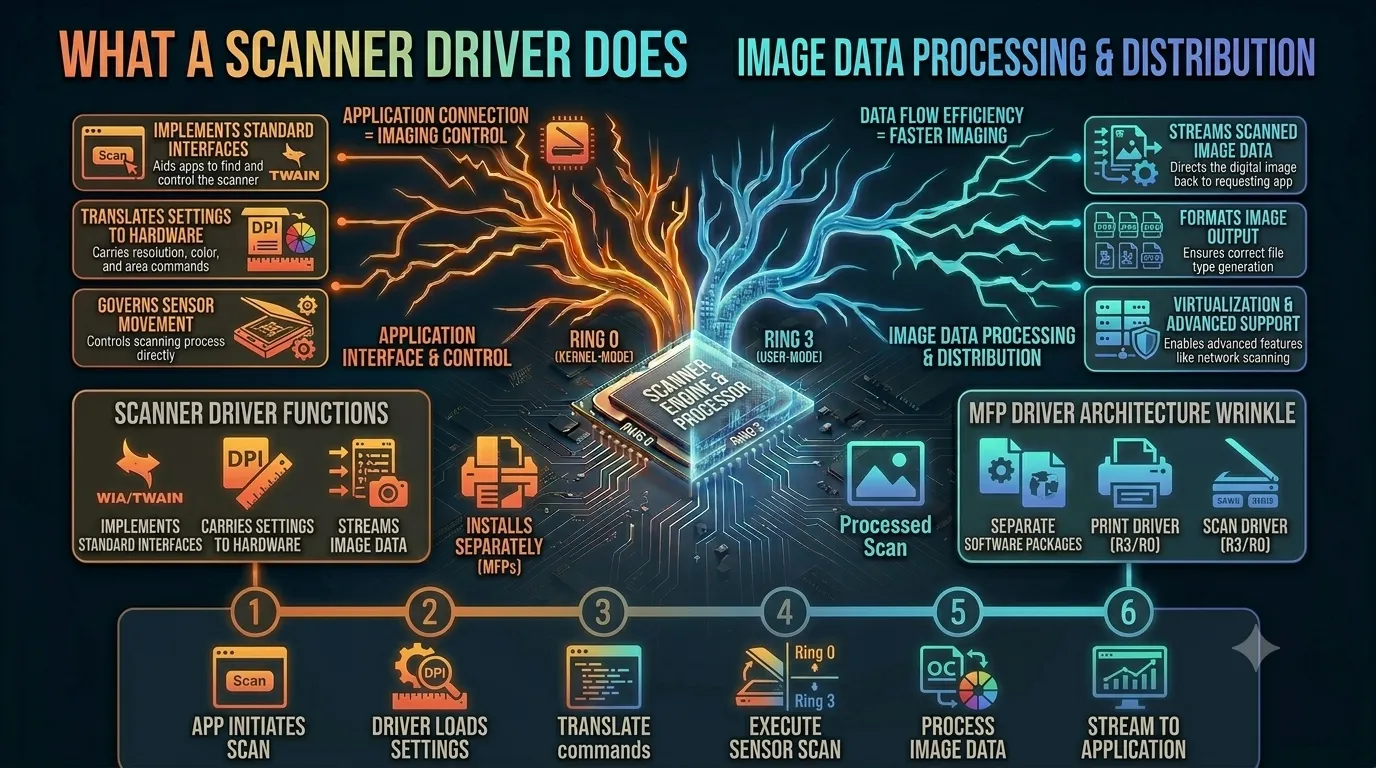
A scanner driver implements the standard scanning interfaces that imaging applications rely on. When any app asks for “a 300 dpi colour scan of this area”, the driver translates that request into hardware commands, runs the sensor across the page, and streams the image data back to whichever program asked.
On multifunction printer-scanner devices there's an important wrinkle: the scanning driver is a separate piece of software from the printing driver. They ship together in the maker's full package — but a print-only installation quietly leaves scanning out, which explains one of the most common support mysteries.
Implements the standard interfaces scanning apps rely on
Carries resolution, colour, and area settings to the hardware
Streams the scanned image back to your software
Installs separately from printing on multifunction devices
When the Printer Works but the Scanner Doesn't
It's the classic multifunction complaint: printing is flawless, yet every scanning app insists no scanner exists. Nine times out of ten, the machine was set up with a basic or print-only driver, and the scanning half of the software simply was never installed.
The second classic is network scanning: printing travels one way, but scans travel back from the device to your computer — and a firewall can silently block that return path. Installing the maker’s full package and allowing its scan utility through the firewall resolves the overwhelming majority of cases.
Fix it in five careful steps
- 1.
Test with the maker's own utility — If the manufacturer's scan tool sees the device, the driver is fine and the problem is in the other application's settings.
- 2.
Install the FULL package — Download the complete software bundle for your exact model — the version that includes scanning support, not just the basic print driver.
- 3.
Open the firewall for network scanning — Allow the manufacturer's scanning utility through your firewall so scanned images can travel back to the computer.
- 4.
For USB: go direct — Connect the scanner directly to a USB port on the computer using a known-good cable and avoid hubs while troubleshooting.
- 5.
Restart both ends — Power-cycle the scanner and restart the computer, then run a test scan using the operating system's built-in scanning tool.
If anything here feels out of your depth, that's perfectly normal. A local technician can usually perform this entire routine in minutes, and nothing on this page requires specialist tools.
Common Device Manager codes
These are the most common Device Manager errors and what they usually mean.
| Code | What It Means In Plain English | The Usual Fix |
|---|---|---|
| Code 28 | No driver is installed for the device. | Install the correct driver from the manufacturer. |
| Code 10 | The device cannot start. | Reinstall the driver and restart the computer. |
| Code 45 | The device isn't currently connected. | Reconnect the device and check cables or power. |
| Code 19 | The device's configuration information is damaged. | Uninstall the device and let Windows reinstall it. |
Frequently Asked Questions
The questions readers ask most about scanner drivers and scanning problems.
On multifunction devices, printing and scanning use separate drivers. A quick or print-only installation often includes only the printing component. Download and install the full software package for your exact model to add the scanner driver and scanning utilities.
Scanning sends data from the device back to your computer, and firewalls can sometimes block that incoming connection. Allow the manufacturer's scanning software through your firewall and make sure both the scanner and computer are connected to the same network.
Check the manufacturer's support page for a driver compatible with your operating system version. If official support has ended, the operating system's built-in scanning tools may still provide basic functionality, although advanced features might no longer be available.
Want us to explainanother driver topic?
Our friendly overview covers every major hardware category — from the device on your desk to the chips inside your laptop. Tell us what to write next.