
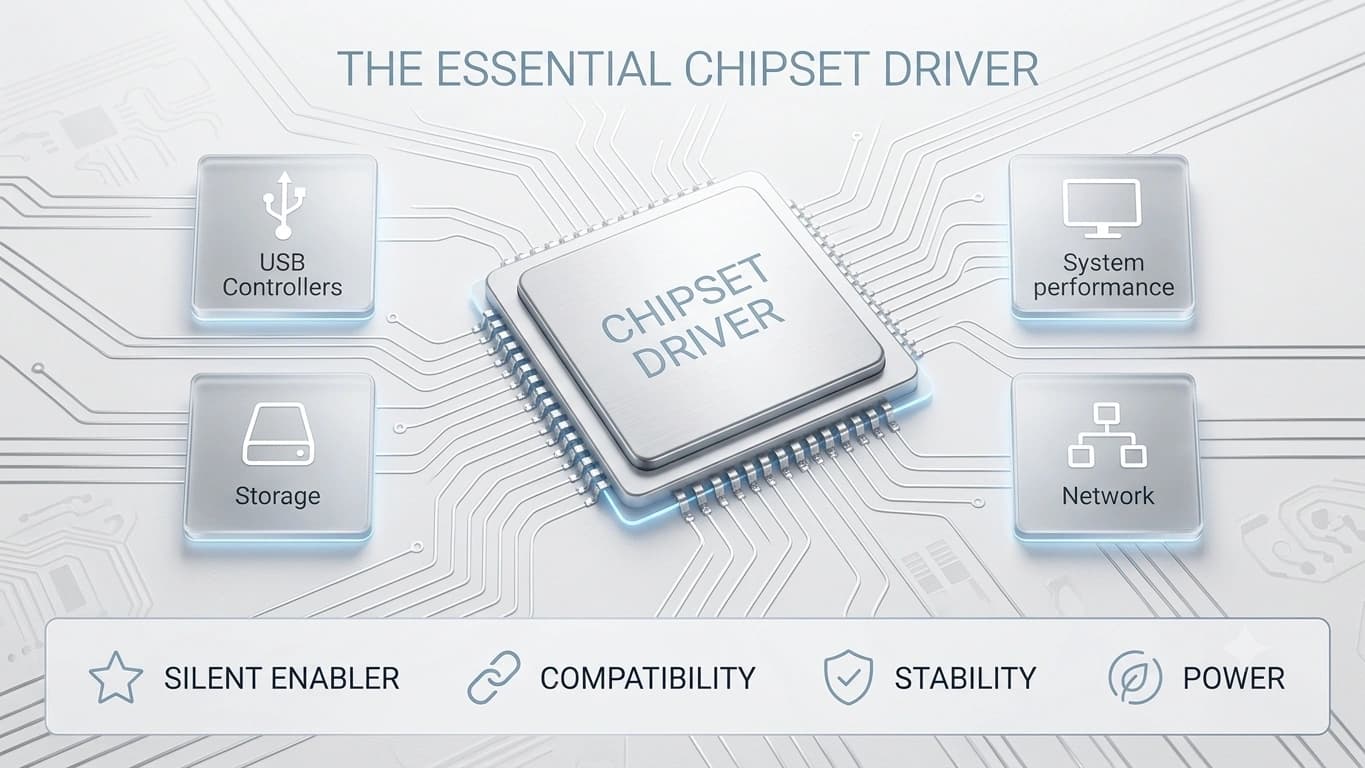
It has no fans, no settings app, and no fame — yet the chipset driver is the most foundational software on your PC.
What the chipset actually is
Your processor doesn't talk to the world directly. A companion set of silicon — the chipset — manages the traffic: which lanes connect to storage, how USB controllers are wired, how power flows between states, how all the buses that other devices ride on are organised. The chipset driver package teaches the operating system the specific map of your board.
Generic works. Tuned works better.
Fresh operating-system installs boot fine without the maker's chipset package because the OS carries generic fallbacks. Generic means functional, not optimal: power states may be conservative, performance features unrecognised, and some devices may sit in the device manager wearing little warning marks because the system can't fully identify what bus they live on. Installing the board maker's chipset package replaces guesswork with the real map — and it's common to watch several seemingly unrelated warnings clear at once when it lands.
The symptoms nobody attributes correctly
Chipset problems wear disguises. Sleep that never resumes properly. USB ports that behave differently from each other. A machine that feels vaguely slower after a major OS update — which may have swapped tuned drivers for generic ones. Because no symptom says "chipset" on its face, the layer gets overlooked, and people chase the visible drivers instead. When weirdness is spread across unrelated devices, think foundation, not fixtures.
First on, rarely touched
The rule of thumb is simple: the chipset package goes on first after a fresh install — before graphics, before audio, before peripherals — because everything else enumerates on top of it. After that, it needs attention rarely: when the maker ships an update fixing something you've noticed, or after a major OS upgrade.
Where to get it
Desktops: your motherboard maker's support page for your exact board model. Laptops: your laptop maker's page for your exact model number. Never a third-party "driver site" — the foundation layer is the last place to accept software of unknown provenance. It will never be famous. But install it first, from the right source, and a whole class of mystery problems simply never happens.
End of Article
Written and maintained by the PC Driver Info editorial team